Learning how to start a supplement company is not about making one decision — it is about making a sequence of decisions in the right order. Whether you are researching how to create a supplement brand from scratch or migrating an existing product to a US manufacturer, the order matters more than any single choice. Founders who launch cleanly are not the ones who make the best product; they are the ones who make each decision at the right time, before the cost of revisiting it multiplies.
Here is the realistic path from idea to first shipment, broken into the stages that actually consume time and money.
1. Decide what you are actually building
Before you talk to a manufacturer, answer three questions honestly. They determine everything downstream — cost, timeline, and which manufacturer can even take the project.
- Formula or concept? Do you have a finished formula (OEM), a concept you want a manufacturer to formulate (ODM), or are you happy to put your brand on a proven house formula (white label)? These are different projects with different timelines. Read our OEM vs ODM vs Private Label breakdown to pick the model that fits your stage.
- What format? Softgel, capsule, tablet, gummy, powder, liquid, or daily pack? Format drives the manufacturer (not every plant runs every format) and the cost structure.
- What channel? Amazon, your own DTC site, retail (Costco, Target, Wegmans), or clinic/practitioner? Channel shapes compliance — Amazon enforces label and claims differently than a retail buyer, and each adds its own documentation step.
A founder who skips these questions and emails "I want to start a supplement brand, what does it cost?" will spend weeks in back-and-forth that a complete brief would have answered in one reply. See How to Brief a Contract Manufacturer for the exact fields a manufacturer needs to quote.
2. Understand MOQ before you set a budget
The single number that shapes your launch cost more than any other is MOQ — minimum order quantity. It is not a detail you negotiate at the end; it is the constraint that defines what is even possible.
- Softgels typically start at 300,000–500,000 units.
- Capsules and tablets commonly start around 200,000 units.
- Powder starts around 1,000 kg.
If your launch budget assumes 5,000 bottles, those MOQs are a wall, not a starting point. Read What Is MOQ in Supplement Manufacturing? for how MOQ is set and how to use it to your advantage — including which formats have lower entry points if you are testing a concept.
3. Pick a manufacturer that can actually run your product
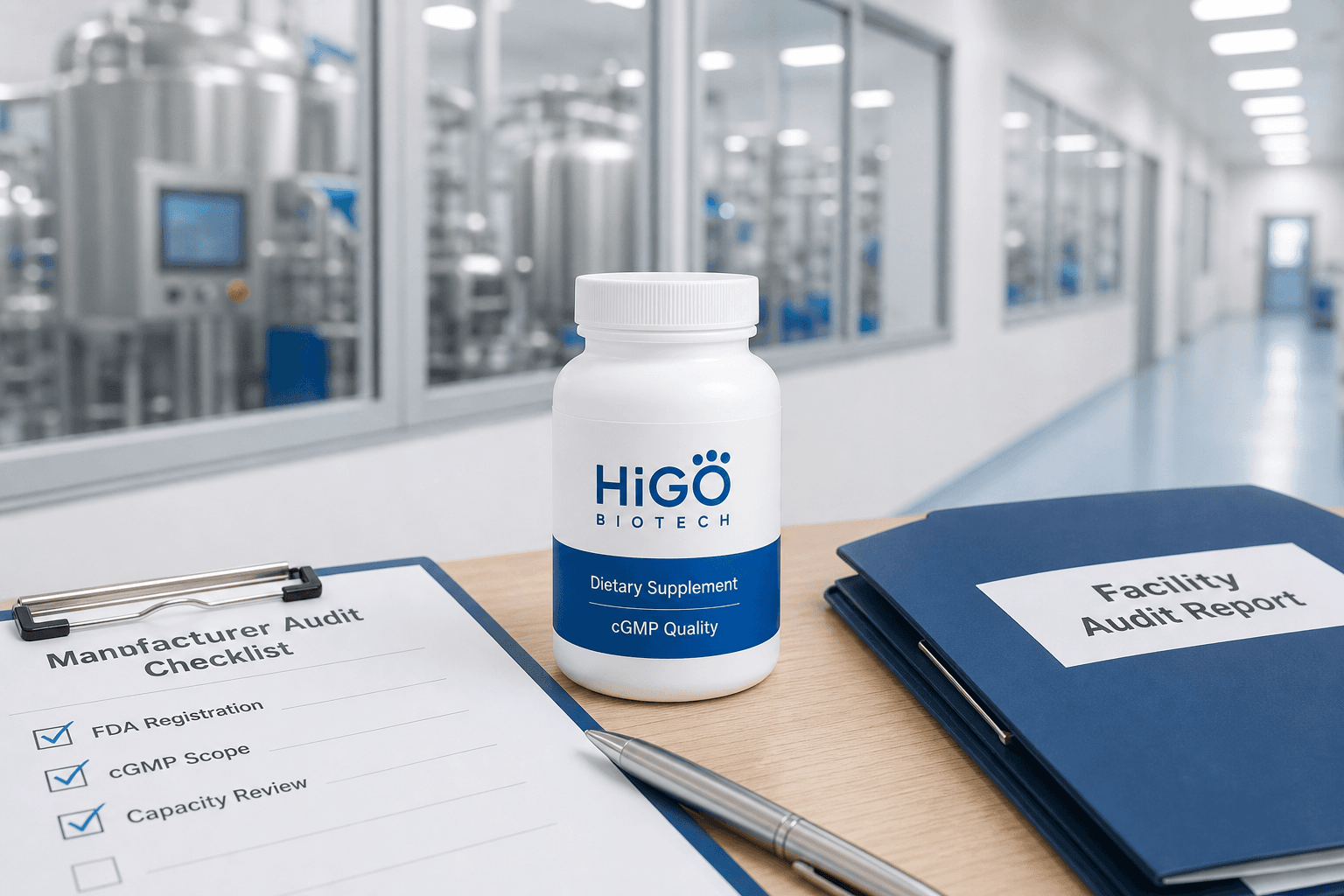
Every credible manufacturer has a cGMP certificate. That certificate tells you a facility was audited — it does not tell you whether this facility can run your format, on your timeline. Vetting a partner means checking four things: registration and scope, documentation depth, real capacity, and a technical call before the PO. The full checklist is in How to Vet a Supplement Contract Manufacturer. For an overview of what a full-service partner covers — formulation through finished goods across every dosage format — see our nutraceutical manufacturing capabilities.
The short version: a manufacturer who welcomes a facility audit, an MMR review, and a formulator call is one you can build a multi-year program with. One who deflects those questions is one you will re-source from in twelve months.
4. Formula, compliance, and the NDI trap
This is the stage where launches quietly die — not in production, but in compliance review. Three things catch brands here:
- New Dietary Ingredients (NDI). Any ingredient first marketed in the US after October 15, 1994 is an NDI, and using one without an FDA notification can get your product pulled from shelves. Many trendy botanicals and branded actives sit on this list. See New Dietary Ingredient (NDI) Notification to check whether your formula is exposed.
- Label compliance. Your Supplement Facts panel, claims, and required label elements are regulated, and Amazon and retailers enforce them harder than the FDA. A missing sesame declaration or a wrong %DV can fail a vendor review or trigger a class action. The full rules are in Supplement Facts Label Compliance Guide.
- Stability and shelf life. The expiry date on your label is only as honest as the stability protocol behind it. If you claim 24 months, you need real-time data, not just accelerated. See Supplement Shelf Life & Stability Testing.
The pattern: regulatory questions get more expensive the later you ask them. Caught at formula stage, an NDI is a substitution. Caught after launch, it is a recall.
5. Build a manufacturing-grade spec sheet
Retail and marketplace onboarding fail when the spec sheet is marketing copy. A manufacturer needs a specification — every active with an amount and assay method, every botanical with a Latin name and plant part, allergen declarations, release tests, and version control. The checklist is in Building a Retail-Ready Spec Sheet. Send it with your quote request, not after sampling.
6. Map the timeline and protect it
Founders often plan for four weeks. Real US cGMP timelines are longer — and entirely predictable if you stage decisions correctly. The realistic path is roughly 11 weeks from brief to shelf-ready when decisions stay on schedule:
- Week 0–1: Brief and quote.
- Week 1–3: Sampling.
- Week 3–5: Feedback and lock.
- Week 5–10: Materials and production.
- Week 8–12: Release and ship.
The stages that eat weeks are the ones that depend on decisions, not capacity — raw-material lead time, packaging tooling, and stability. Sample to First PO: Manufacturing Timeline breaks down where the time goes and how to compress it without cutting corners.
7. Launch, then iterate
First production is not the finish line — it is the start of the next cycle. The brands that scale are the ones who treat the first PO as a learning run: they watch which claims convert, which channel performs, and which SKUs deserve a second production run at higher volume. Reordering at higher volume is also where unit economics improve, because MOQ and price breaks favour commitment.
The short version
Starting a supplement company is not about making one good product. It is about making a sequence of decisions — model, format, channel, manufacturer, compliance, timeline — in an order that keeps your options open and your costs down. The founders who launch in 11 weeks instead of 11 months are not luckier; they decided earlier.
Ready to map your launch? Start a quote with your format, volume, and target launch week — we will reply within 24 hours with MOQ fit, pricing direction, and a sample plan.


 Free Quote