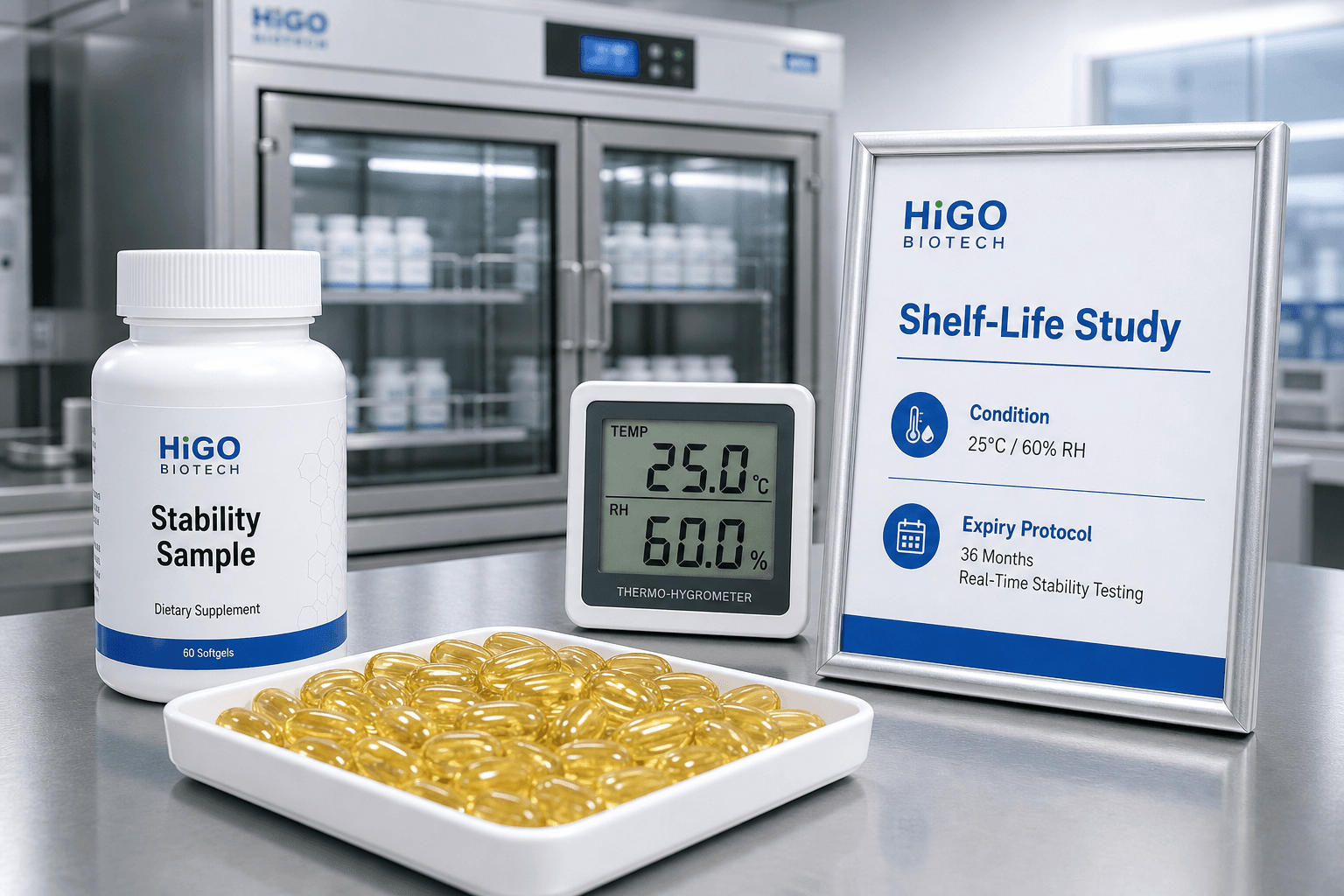
The expiry date printed on your bottle is a promise to the consumer: inside this window, the product delivers the dose on the label, and outside it, we will not stand behind it. That promise is only as good as the stability data behind it — and most brand founders never ask to see that data.
Here is how supplement shelf life actually gets established, and what to require from your manufacturer so your expiry date means something.
How shelf life is established
Shelf life is not a guess. It is derived from a stability study: a structured program that stores samples of your product under defined conditions and tests them at intervals to see when they stop meeting specification.
A defensible stability program has four parts:
- Defined storage conditions — typically 25°C / 60% RH (long-term, "ICH standard") and 40°C / 75% RH (accelerated).
- Defined timepoints — at minimum 0, 3, 6, 9, 12 months for accelerated; 0, 6, 12, 24 months for long-term.
- Defined test panel — potency of the active, microbial limits, and the failure modes specific to the format (see below).
- A clear pass/fail spec — e.g. "potency remains ≥90% of label at expiry."
If your manufacturer cannot show you the protocol, the expiry date on the label is an assumption, not a result.
Accelerated testing: useful, but not the whole story
Accelerated stability (40°C / 75% RH for 6 months) is how manufacturers extrapolate a multi-year shelf life without waiting years. It is a good early signal — but it has real limits:
- It over-predicts for some actives. Vitamins sensitive to heat (C, B12) can fail accelerated while surviving fine at room temperature.
- It under-predicts for humidity-driven failure. A powder that cakes in real warehouses may look fine in a sealed accelerated chamber.
- It does not model distribution. Your product will sit in a hot truck, a shipping container, and a warehouse before it reaches a shelf. Real-world stability is different from lab stability.
This is why credible programs run both accelerated (for a fast early read) and long-term (for the number that actually goes on the label). A manufacturer offering only accelerated data is selling you a forecast, not a measurement.
What goes wrong, by format
Each dosage format has its own characteristic failure modes. Stability testing has to target them specifically, not just re-run a generic potency panel.
- Softgels — oxidation of oil fills, shell leakage, bloom (white haze from temperature cycling), welding/sticking in the bottle.
- Two-piece capsules — brittleness and splitting in dry climates, microbial risk in wet fills, disintegration slowdown.
- Tablets — friability (crumbling), hardness drift, disintegration time, colour change in light-sensitive coatings.
- Powders and stick packs — caking and clumping from humidity, flavour fade, loss of probiotic viability.
- Liquids — phase separation, preservative efficacy, microbial growth, leaching from the dropper or bottle.
A stability protocol that runs the same five tests on every format is not actually testing the risks. Ask which failure modes the program is designed to catch.
What to require from your manufacturer
Before you approve an expiry date, ask for:
- The stability protocol — conditions, timepoints, test panel, and the failure modes it targets.
- Real-time data, not only accelerated — especially if you are claiming 24+ months.
- Stability data for your specific formulation — not "a similar product we ran last year." Ingredient interactions matter.
- A pilot-lot stability study before you commit to full production volume. Catching a failure at 10,000 units is survivable; at 100,000 it is not.
- Distribution-condition testing if your product will see extreme climates or export shipping — temperature cycling reveals what static chambers hide.
The commercial reality
Stability testing costs money and takes time — typically the single largest chunk of the timeline between sample approval and first PO. Brands that try to skip it "to launch faster" end up re-formulating after a field failure, which is far slower and far more expensive.
A 24-month shelf life backed by 12 months of real-time data is worth more than a 36-month claim backed by six months of accelerated. Retailers know this. Amazon's compliance portal knows this. Consumers find out the hard way.
If you are planning a launch: build the stability study into your timeline from day one. At HiGO we sequence pilot stability alongside the first production run so you get a defensible expiry date without adding months to your critical path — ask us how when you brief your project.


 Free Quote