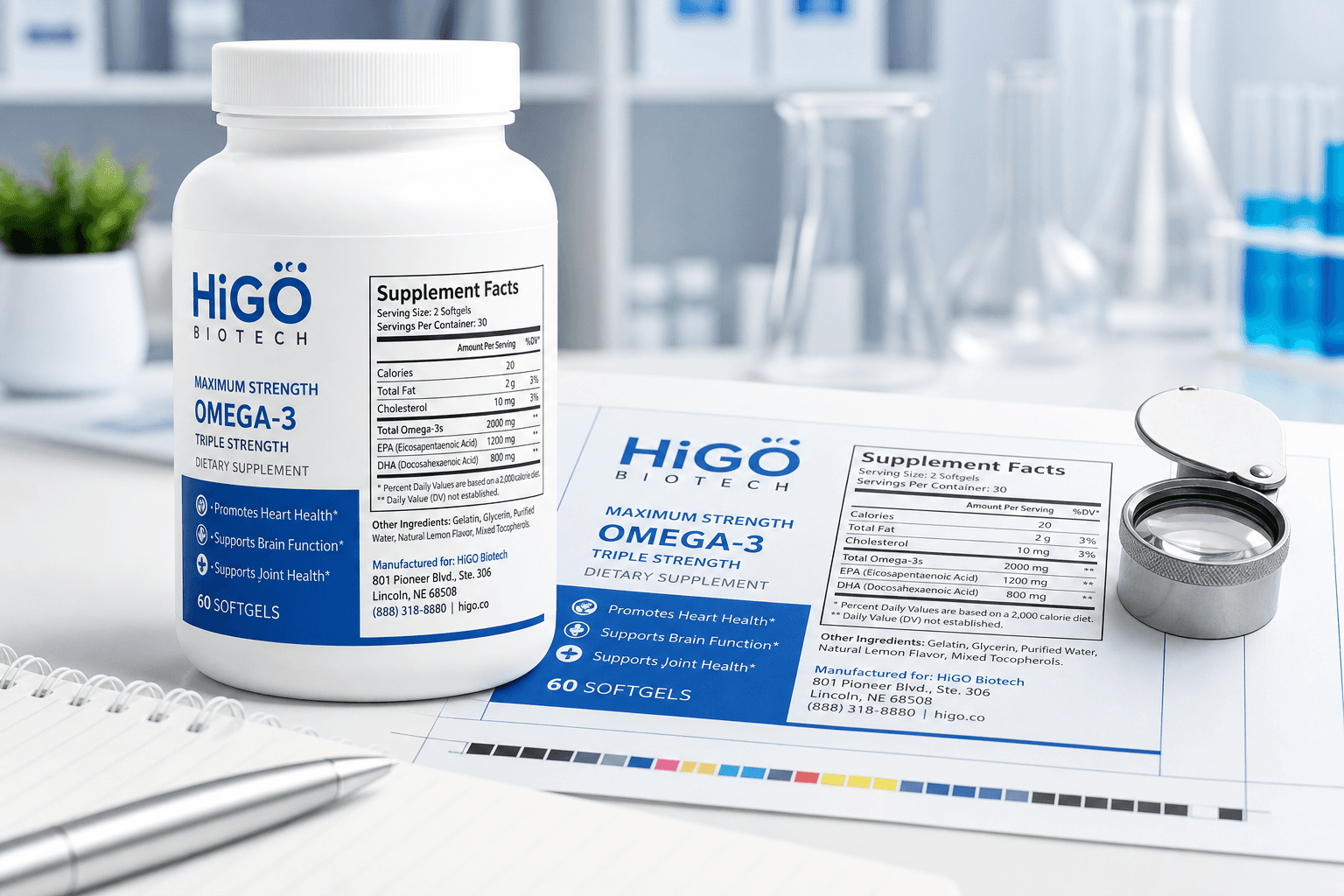
A supplement label does two jobs at once. It tells the consumer what is in the bottle, and it is a legal document the FDA, Amazon, and every major retailer reads against a specific rulebook. Most brands spend 95% of their label effort on the design and 5% on the compliance — and then wonder why their Amazon listing gets suspended three weeks after launch.
Here is the label compliance that actually catches brands, and how to design for it from the start.
The Supplement Facts panel is not optional, and it is not flexible
The Supplement Facts panel is the regulated nutrition box on your label. Under 21 CFR 101.36, it has rules most designers do not know exist:
- Serving size must be declared in a specific unit (capsules, tablets, grams, mL) and must match how the product is used.
- Dietary ingredients are split into two columns: vitamins/minerals with Daily Value (DV), and all other ingredients (botanicals, amino acids, enzymes) without DV.
- Quantitative amounts must be listed per serving — not just a proprietary blend total. A "proprietary blend" line lets you hide the ratios inside the blend, but you still must declare the total blend weight.
- Source units for botanicals matter: "Ginseng (Panax quinquefolius) root extract, 100 mg" is compliant; "Ginseng 100 mg" is not, because it does not identify the plant part or species.
- %DV must use the current reference values, not the 1968 RDAs. The FDA updated these in 2016 and plenty of labels still show the old numbers.
A panel that looks clean to a designer can still be non-compliant on these points. The rule of thumb: if the panel was built in Canva, it probably is not compliant.
Three claim categories — and the one that sinks launches
Claims on a supplement label fall into three FDA buckets, and the line between them is where brands get into trouble.
- Health claims — "calcium reduces the risk of osteoporosis." These require FDA authorisation or significant scientific agreement. Very few exist. Most brands cannot use these.
- Structure/function claims — "supports joint health," "promotes immune function." These are allowed under DSHEA, but require three things: a substantiation file, the disclaimer ("This statement has not been evaluated by the FDA…"), and FDA notification within 30 days of first marketing.
- Disease claims — "treats arthritis," "cures diabetes." These are not allowed on a dietary supplement. They re-classify your product as an unapproved drug.
The trap is the gray area between structure/function and disease. "Supports healthy blood sugar" is defensible; "lowers blood sugar in diabetics" is a disease claim. "Supports joint comfort" is fine; "treats joint pain" is a disease claim. Amazon's compliance bots are tuned to catch the disease-claim patterns even when the FDA is slow to.
The required label elements most brands forget
Beyond the Supplement Facts panel, a compliant US supplement label must include:
- Identity statement — "Dietary Supplement" (or the specific type, e.g. "Vitamin C Dietary Supplement").
- Net quantity — in both metric and, for the US market, the appropriate count or weight statement, placed in the lower 30% of the front panel.
- Ingredient list — outside the Supplement Facts panel, listing all non-dietary ingredients (excipients, fillers, capsule materials, flavours) in descending order.
- Major allergens — if the product contains milk, egg, fish, shellfish, tree nuts, wheat, peanuts, or soybeans, declared by common name. Sesame is now the ninth major allergen as of 2023.
- Manufacturer/distributor name and address — with a US address or phone number for adverse event reporting.
- Adverse event reporting statement — "To report a serious adverse event, call…" This became mandatory in 2006 and is still missing on many labels.
- Lot number and expiry — not federally required for supplements, but required by virtually every retailer and marketplace.
Why this matters more than it used to
FDA enforcement is slow and understaffed. But third-party enforcement is not:
- Amazon requires a Supplement Facts image upload and runs pattern-matching on claims. Non-compliant listings get suppressed within days, not years.
- Retailers (Costco, Wegmans, Target) run label reviews as part of vendor onboarding. A bad Supplement Facts panel fails the review and delays the listing fee.
- Plaintiff's lawyers in California target labels with the wrong %DV, missing allergens, or implied disease claims under Prop 65 and false advertising statutes. A single missing sesame declaration can become a class action.
The cost of fixing a label before it prints is an artwork revision. The cost of fixing it after 50,000 bottles are filled is a recall.
How to build a compliant label from the start
- Get the Supplement Facts panel built or reviewed by someone who knows 21 CFR 101.36, not just a designer.
- Lock your claims before artwork starts, and keep a substantiation file for each one.
- File the FDA structure/function notification within 30 days of first marketing — it is a one-page form and free, but missing it is technically non-compliance.
- Run the full required-elements checklist above against the final artwork, before it goes to the printer.
- Keep the lot/expiry and adverse-event statement on every SKU, even if you think the channel does not require it.
A manufacturer who has run dozens of compliant labels can save you weeks here. At HiGO, our artwork review catches the common Supplement Facts and claim issues before proof — but the earlier you bring compliance into the design conversation, the cleaner the launch.
If you are designing a label now: send us the draft artwork and the intended claims. We will flag the compliance risks against current FDA rules before you print.


 Free Quote