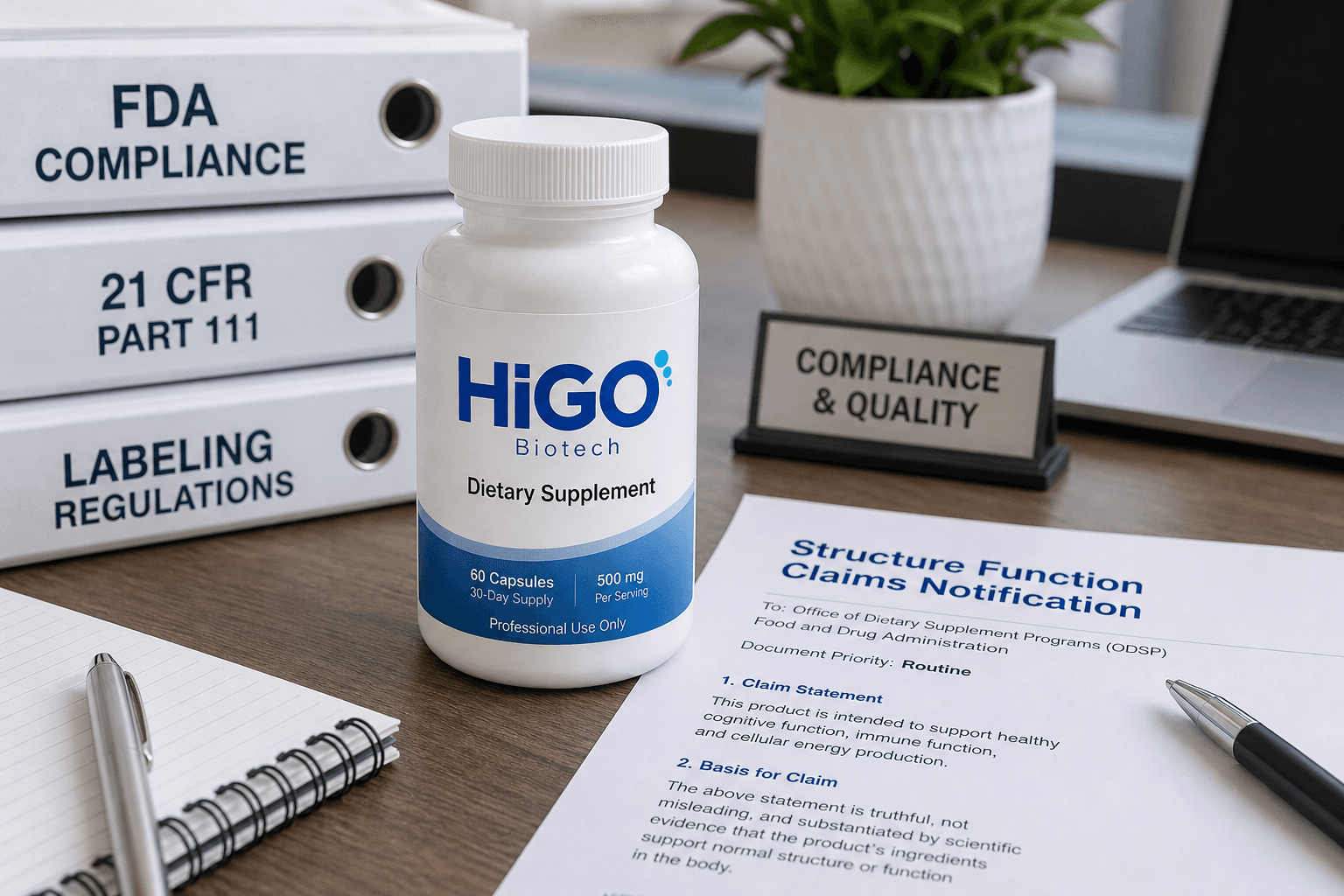
One of the most common confusions we hear from brand founders: "How do I register my supplement with the FDA?" The short answer is — you don't, at least not the way most people think. Here's how U.S. supplement compliance actually works.
You notify, you don't register
Under DSHEA (the Dietary Supplement Health and Education Act), dietary supplements are not pre-approved by the FDA before they go to market. Instead:
- The facility that manufactures, packs, or holds the supplement must be registered with the FDA.
- The product itself must be notified to the FDA via a New Dietary Ingredient (NDI) notification only if it contains a new dietary ingredient. Most standard formulas don't trigger this.
- The manufacturer/packer must submit a structure/function claim notification within 30 days of marketing, if the label makes a structure/function claim (e.g., "supports immune health").
So the facility is registered; the product is generally notified (for claims), not approved.
What this means for your launch
- No FDA sign-off before you sell. You can go to market without waiting for FDA clearance — but you bear the burden of safety and claim substantiation.
- Your manufacturer's facility registration is your baseline. Ask for proof. A cGMP-certified, FDA-registered facility is the floor, not a differentiator.
- Your claims need evidence. Structure/function claims must be truthful, not misleading, and substantiated. "Cures" and disease claims are not allowed.
The three things that actually get brands in trouble
- Disease claims. Saying a supplement "treats," "cures," or "prevents" a disease crosses into drug territory and triggers FDA action.
- Unsupported structure/function claims. Even allowed claims need substantiation files. "Supports immune health" is fine; "prevents colds" is not.
- Adverse event reporting (AER). Manufacturers and distributors must report serious adverse events. Skip this and you're out of compliance regardless of your formula.
What a good manufacturer supplies
A credible partner gives you, with every batch:
- Facility FDA registration evidence
- cGMP certificate (NSF/SGS)
- Certificate of Analysis (COA) for finished goods
- Documentation supporting any structure/function claims your formula qualifies for
That documentation pack is what retailers and marketplaces increasingly demand — and what protects you if the FDA asks.
The bottom line
You don't register your supplement; your facility registers, and you notify your claims. Get the facility right (cGMP, FDA-registered), substantiate your claims, and you've cleared the compliance bar. The rest is good manufacturing — which is what a cGMP partner delivers every batch.


 Free Quote